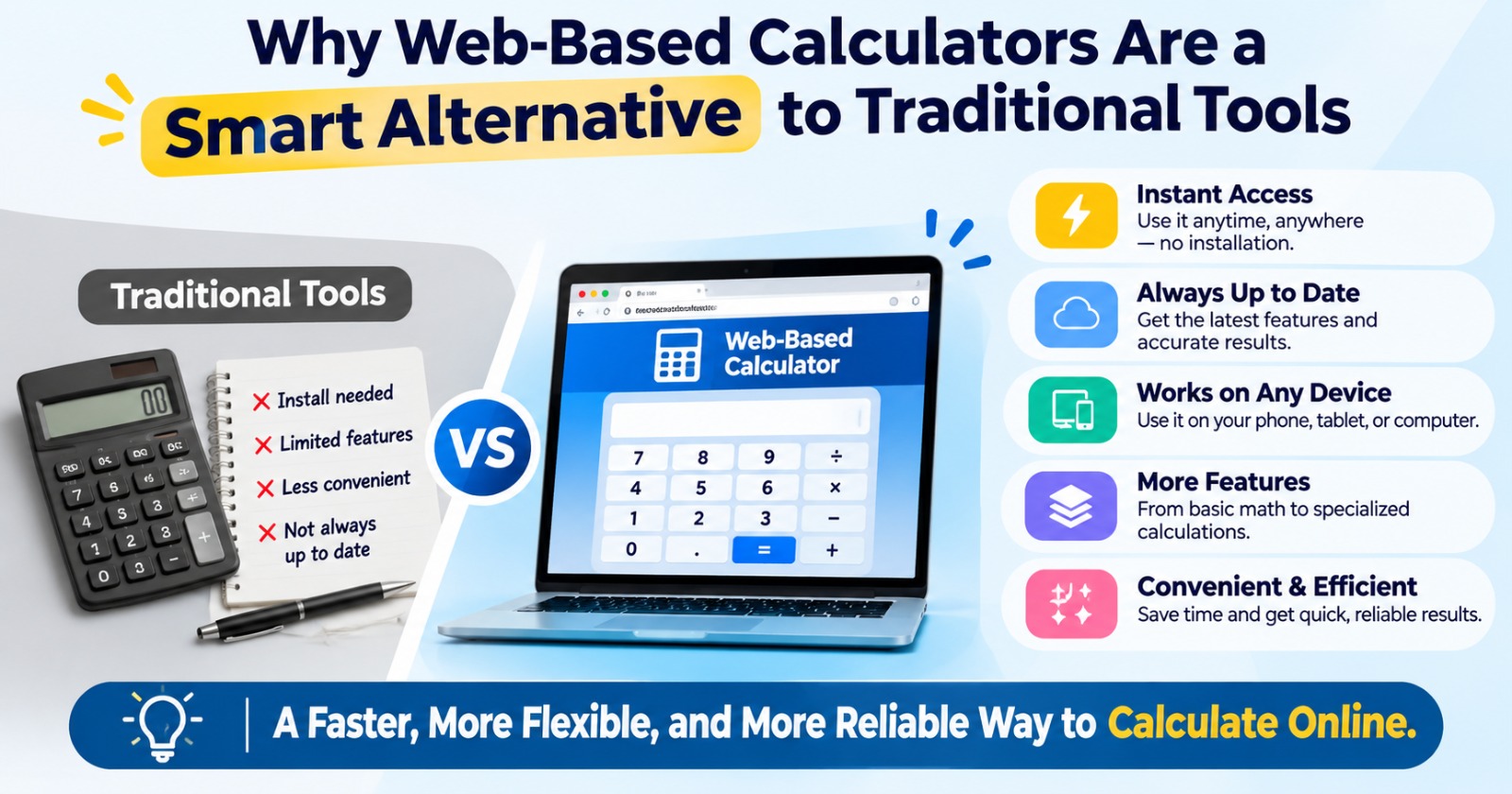
Web-Based Calculators are becoming an increasingly popular alternative to traditional calculation tools because they offer convenience, accessibility, accuracy, and flexibility in one place. Whether someone needs to perform basic mathematical calculations, estimate financial figures, convert units, or solve complex equations, online calculators make these tasks easier without requiring physical devices or dedicated software installations. As businesses and individuals continue to adopt digital solutions, browser-based calculators are changing how everyday calculations are performed.
Traditional calculators have served users for decades, but their functionality is often limited to the features available on the physical device. In comparison, modern online calculators provide access to multiple calculation options through a single platform. Users can simply open a browser, select the required calculator, enter the values, and receive results within seconds. This combination of speed and accessibility makes digital calculation tools a practical choice for students, professionals, business owners, and everyday users.
1. Easy Accessibility Without Additional Equipment
One of the biggest advantages of web-based calculators is that they can be accessed from almost any internet-enabled device. Unlike traditional calculators, which require users to carry a separate physical device, online calculators are available through smartphones, tablets, laptops, and desktop computers.
Universal Financial Calculators make managing your money easier with quick and accurate calculations for everyday financial needs. Plan budgets, estimate savings, calculate loans, and make smarter financial decisions with confidence.
This accessibility is particularly useful for people who frequently switch between devices or work from different locations. For example, a student can use an online math calculator while studying on a laptop, while a business professional can access a financial calculator through a smartphone during a meeting.
Most browser-based calculators do not require software downloads or complicated installation procedures. Users can access the required functionality directly through a website, making the overall experience simple and convenient.
2. Multiple Calculation Options on a Single Platform
Calculators for solving quadratic equations online provide quick and accurate solutions to complex algebraic problems. Find equation roots, simplify calculations, and understand step-by-step solutions with ease.
Web-based calculators solve this problem by bringing different calculation functions together. Depending on the platform, users can find tools for mathematics, finance, health-related measurements, business estimates, and everyday conversions.
Some commonly available online calculator categories include:
- Mathematical calculatorsUseful for addition, subtraction, multiplication, division, percentages, algebra, and scientific calculations.
- Financial calculatorsHelp users estimate loan payments, interest amounts, savings, investments, and monthly budgets.
- Unit conversion calculatorsConvert measurements such as length, weight, temperature, distance, and volume.
- Date and time calculatorsCalculate age, date differences, working days, and time durations.
- Business calculatorsAn Online Income Tax Estimator India helps you quickly calculate your tax liability, estimate take-home income, and plan your finances with greater accuracy and confidence.
Having access to multiple calculator tools through one platform reduces the need to search for separate devices or applications for different tasks.
3. Comparison Between Web-Based Calculators and Traditional Tools
Both traditional calculators and online calculators have their own advantages. However, their usefulness can vary depending on the user's requirements, working environment, and calculation needs.
The following table highlights the major differences between them.
| Comparison Factor | Web-Based Calculators | Traditional Calculators |
|---|---|---|
| Accessibility | Available through internet-enabled devices | Requires a physical calculator |
| Installation | Generally no installation required | No installation, but requires purchasing a device |
| Functionality | Can offer multiple specialised calculation options | Limited to built-in functions |
| Updates | Features can be updated by the website provider | Hardware functionality generally remains unchanged |
| Device Compatibility | Accessible through supported web browsers | Independent of browsers or internet access |
| Convenience | Easy to access from different locations | Must be physically carried |
| Cost | Many tools are available free of charge | Usually involves an initial purchase cost |
The comparison shows that online calculators offer greater flexibility when users need different calculation functions. Traditional calculators, however, remain useful in situations where internet access is unavailable or external devices are restricted.
Therefore, choosing between the two depends on the nature of the task. For regular calculations, a traditional device may be sufficient, while web-based tools provide additional convenience for varied and specialised requirements.
4. Faster Calculations and Improved Productivity
Time management is important in both personal and professional activities. Repeated calculations can consume valuable time, especially when users need to work with multiple figures or perform similar calculations throughout the day.
Online calculators simplify these tasks by providing ready-to-use functions. Instead of manually applying formulas or searching for calculation methods, users can enter the required information and obtain results quickly.
These tools help reduce repetitive work and allow users to focus on more important tasks. In professional environments, this can improve workflow efficiency and support better time management.
Plan budgets, loans and savings in seconds.
Try Financial Calculators →5. Better Accuracy and Reduced Calculation Errors
Accuracy is another important reason why people prefer digital calculation tools. Manual calculations can sometimes result in errors, particularly when working with large numbers, decimal values, multiple variables, or complicated formulas.
Web-based calculators use programmed mathematical operations to generate results based on the values entered by users. This reduces the possibility of common arithmetic mistakes associated with manual calculations.
Specialised calculators also help users apply the correct formulas without having to remember every calculation method. For instance, a loan calculator can estimate monthly instalments based on the principal amount, interest rate, and repayment duration.
However, accuracy also depends on the quality of the calculator, the correctness of its formulas, and the information entered by the user. Reliable platforms should clearly explain their calculation methods and provide appropriate instructions.
6. Cost-Effective Solutions for Individuals and Businesses
Another benefit of online calculators is their affordability. Many websites provide free online calculators for everyday use that users can access without purchasing separate devices or paying for specialised software.
For individuals, this means having access to different calculation functions without investing in multiple physical calculators. Students can use educational calculators, while households can access budgeting and conversion tools whenever required.
Businesses can also benefit from these solutions. Instead of purchasing separate software for every basic calculation requirement, companies can use browser-based tools to support everyday operations.
For organisations with specific requirements, investing in custom calculator development can provide an even more suitable solution. Businesses can create calculators based on their products, pricing structures, customer requirements, and internal workflows.
7. No Complex Installation and Easy User Experience
Modern users prefer digital tools that are simple to understand and operate. A complicated interface can make even a useful application difficult to use.
Web-based calculators generally provide a straightforward experience. Most tools include clearly labelled input fields, calculation buttons, and result sections. Users do not need advanced technical knowledge to perform basic calculations.
Another advantage is that many online calculator platforms are designed with responsive layouts. This allows the interface to adjust to different screen sizes, making the tools easier to use on mobile phones and tablets.
A well-designed calculator should also provide helpful instructions, clear error messages, and understandable results. These features improve usability and make calculations accessible to a wider audience.
8. How Businesses Can Benefit from Custom Online Calculator Solutions
Beyond everyday calculations, online calculators can also become valuable features of business websites. They can help businesses provide useful information, improve customer engagement, and simplify decision-making.
For example, a construction company may offer a material estimation calculator, while a real estate website may provide a home loan calculator. Similarly, an online retailer can integrate a shipping cost or discount calculator to help customers understand their expenses.
Businesses looking to introduce specialised tools can explore professional web calculator development services to create calculators that match their specific requirements.
A professional development process generally considers:
- Business requirementsIdentifying the calculations customers or employees need.
- Formula accuracyEnsuring that mathematical operations and calculation logic are properly implemented.
- User interface designCreating simple input fields and clearly presented results.
- Mobile responsivenessMaking the calculator accessible across different devices.
- Website integrationEnsuring the calculator works smoothly with the existing website.
600+ free web-based calculators, no download or signup.
Explore All Calculators →