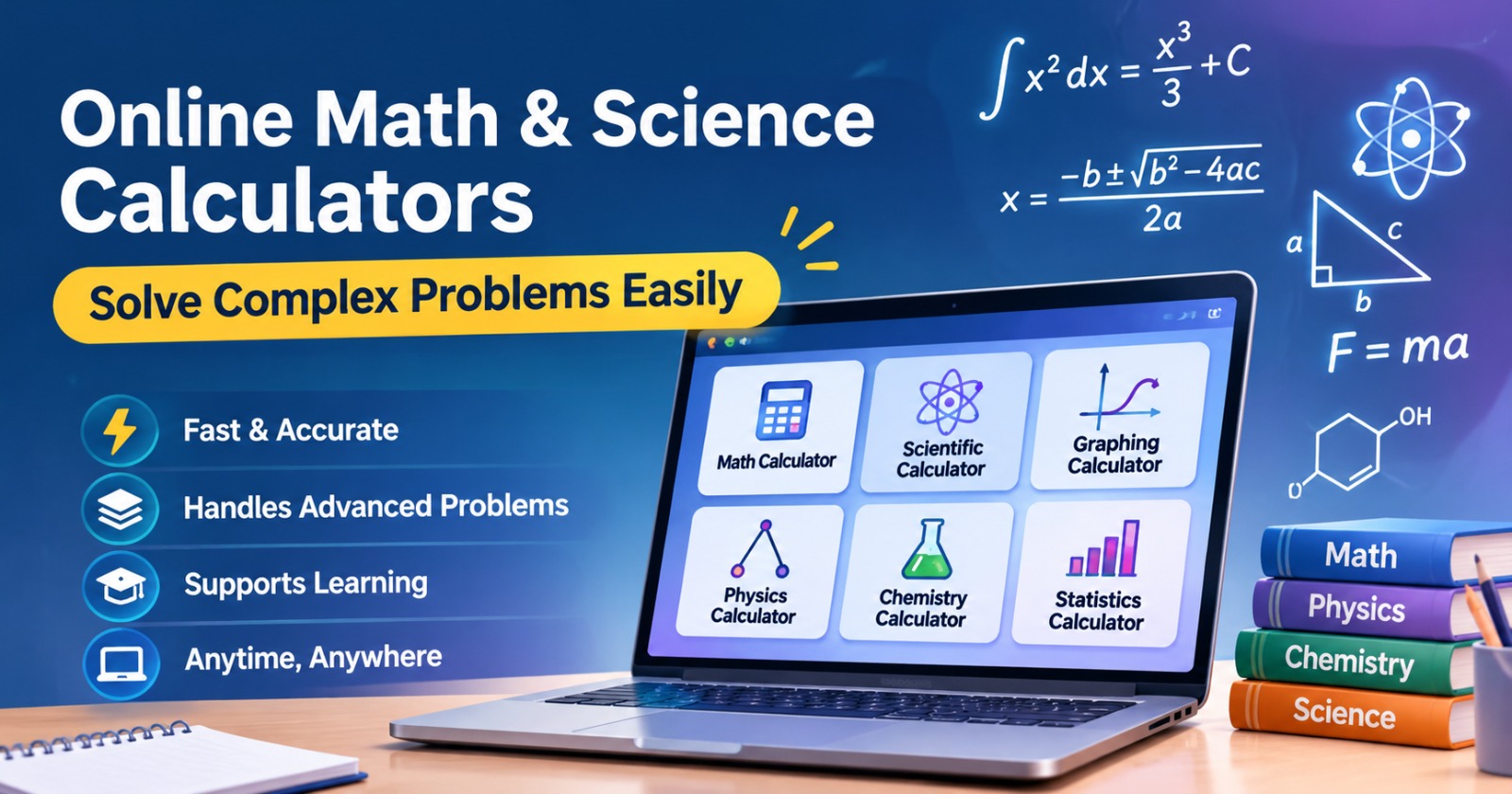
Online Free Math and Science Calculators are very useful tools. They are useful to both students, teachers, researchers, engineers and professionals. Complex calculations and mathematical equations can be quickly and easily completed using online calculators. In turn, instead of taking a substantial amount of time to perform difficult calculations by hand, simply entering values into the calculator will provide answers in seconds.
As online calculators are increasingly available, solving mathematical and scientific equations is becoming much simpler. It is no longer necessary to pay for expensive software, or have advanced technical knowledge. Whether you need to complete a calculation relating to geometry, physics, chemistry, statistics or further mathematics, there are online calculators to simplify the calculation. Using these calculators means fewer calculation mistakes and increased productivity.
Understanding the Role of Online Calculators in Mathematics and Science
There are many mathematical and scientific calculations that can be completed using these calculators. If errors are made in calculations, this can affect the results. Using online calculators can make these calculations easier as they apply specific formulae to the numbers inputted. These are very helpful in complex calculations involving many operations, precise decimal places or a number of variables. Homework can be checked using these calculators and teachers and professionals can save time in checking results or completing technical work.
In recent years, calculators have become more advanced. In addition to the basic operations of addition, subtraction, multiplication and division, there are now specific calculators for particular topics. There are scientific calculators, equation solvers, log calculators, percentage calculators, statistics calculators and scientific unit conversion calculators. As a result, complex calculations can be solved more quickly, and you can focus on understanding the concept behind the question. If used in conjunction with textbooks, explanations in lessons and practice questions, using online calculators can allow students to complete mathematical and scientific work in a more systematic and efficient manner.
How Online Math Calculators Simplify Complex Mathematical Problems
Solving complex mathematical problems such as those containing fractions, exponentials, square roots, logs or complex equations can be difficult. However, online calculators can help by completing mathematical calculations using known mathematical methods. Calculators can be extremely useful to students taking classes in Algebra, Trigonometry, Geometry, Calculus and Statistics, as well as professionals who wish to quickly calculate values in order to complete various technical tasks.
If there are many coefficients within a quadratic equation, there may be many steps needed to find solutions for x. If a problem in trigonometry contains angles or sin, cos or tan, then if accurate decimal places are required, it can be very difficult. Using Trigonometry and Log calculators can make these problems much simpler to solve as you can enter values into the calculator and get your solutions without having to perform each calculation manually.
Examples of mathematical problems that online calculators can simplify:
- AlgebraCalculate unknown variables, simplify expressions, and solve equations involving multiple terms.
- Quadratic equationsFind the roots of equations using coefficients and standard mathematical formulas.
- TrigonometryCalculate sine, cosine, tangent, and inverse trigonometric values for different angles.
- LogarithmsEvaluate logarithmic expressions using different bases and numerical inputs.
- GeometryCalculate the area, perimeter, volume, and dimensions of different geometric shapes.
- StatisticsDetermine averages, percentages, standard deviations, and other statistical measurements.
Why Specialised Mathematical Calculators Matter
Depending on the problem to be solved, a variety of calculators can be used. In academic and professional contexts, complex problems will often require specific calculators. For example, quadratic equation solvers allow the roots of polynomial equations to be calculated. Scientific calculators allow calculations involving powers, roots and trigonometric functions. Additionally, free formula calculators allow common mathematical operations to be performed.
Using these calculators can be very useful as they allow you to easily compare different answers, check your working and perform the same calculation multiple times with different values. This means that less time is spent performing repetitive calculations. Therefore, more time can be spent looking for patterns and relationships within the mathematics, and applying the mathematics to real life problems.
How Science Calculators Support Accurate Scientific Calculations
Whether you are a student or researcher performing scientific calculations, you may be calculating some molarity, molecular weight, density, velocity, force, energy, or another scientific value. If there are multiple measurements, units and decimal numbers it can get very cumbersome to do manually. Using online scientific calculators means that you can easily perform common calculations using pre-set formulas.
Within chemistry calculations, using moles, molar mass, concentration and chemical reactions requires careful consideration. Scientific calculators can be used within chemistry to quickly calculate values and verify results. In physics, calculations can also be simplified using calculators for motion, electrical, pressure and energy values. Calculators can be used within education, preparation of practicals, technical tasks and initial calculations within professional environments.
Some important applications of science calculators include:
- ChemistryCalculate molarity, molar mass, pH, concentration, and stoichiometric quantities.
- PhysicsSolve problems involving force, acceleration, velocity, energy, and electrical measurements.
- BiologySupport numerical calculations related to concentrations, ratios, and experimental measurements.
- Laboratory workCheck formula-based calculations before recording experimental results.
- Unit conversionsConvert scientific measurements between compatible units and measurement systems.
Solve chemistry and physics problems in seconds.
Try Chemistry Tools →Practical Examples of Online Calculators in Everyday Learning and Professional Work
Online calculation tools have many uses. They can be used by students to complete questions, by teachers to create practice questions and by professionals to conduct quick calculations. These tools are very useful in any situation where accurate and fast calculations are required.
An engineering student may be asked to calculate velocity from distance and time in their Physics class. A business analyst might wish to perform calculations in statistics to make sense of data. A learner of chemistry may want to calculate concentrations within solutions. All of these situations can be aided by specific calculation websites without having to open several pieces of software.
Here are three practical examples:
A student needs to solve x² − 5x + 6 = 0. By entering the coefficients into a quadratic equation calculator, the student obtains the roots x = 2 and x = 3. The result can then be checked by substituting both values into the original equation.
A laboratory student dissolves 0.5 moles of a substance to prepare 2 litres of solution. Using the molarity formula, the concentration is 0.25 mol/L. An online chemistry calculator can verify this result and reduce the possibility of arithmetic mistakes.
A student needs to calculate the sine of a 30-degree angle. A scientific calculator returns 0.5, allowing the student to verify the standard trigonometric value without manually evaluating the function.
These are examples of useful online calculators. However, it is very important to input the right numbers and units and understand what formulae are being used. Although the calculation may be accurate, using incorrect numbers or inappropriate assumptions will mean that the result could be misleading.
Why Bulk Calculator Is a Useful Platform for Online Math and Science Calculations
Finding a reliable calculator for every individual subject can be inconvenient, particularly when users regularly switch between mathematical, scientific, academic, and technical calculations. Bulk Calculator addresses this requirement by providing a wide collection of online calculators and digital utilities through one accessible platform. With more than 600 calculators and tools across over 25 categories, the website helps students, educators, professionals, and general users find suitable tools for different calculation requirements.
Academic Calculators, Mathematics & Science Calculators, Chemistry Calculators and tools, Online Physics Calculators, Statistics Calculators and many more categories can all be found on Bulk Calculator. By selecting the correct category, entering required information and completing calculations, results can be generated quickly without needing to download any new software. As the calculator tools are web based, they can easily be used on computers, tablets or smartphones.
Another important advantage is convenience. Rather than visiting separate websites for individual calculations, users can explore multiple categories from a single destination. Most tools process calculations locally in the browser, helping reduce unnecessary data transmission. Bulk Calculator is therefore a practical resource for people who want accessible calculation tools for academic learning, professional tasks, and everyday numerical requirements.
Key USPs of Bulk Calculator include:
- Free accessUsers can access the available calculators without paying subscription fees.
- No registration requiredMost tools can be used directly without creating an account.
- Wide calculator collectionMore than 600 calculators and utilities cover different subjects and everyday requirements.
- Easy-to-use interfaceSimple input fields make calculations convenient for beginners and experienced users.
- Browser-based functionalityMost calculations are processed directly within the user's browser.
- Mobile-friendly experienceUsers can access tools through smartphones, tablets, and desktop devices.
- Multiple subject categoriesThe platform offers resources covering mathematics, chemistry, physics, statistics, finance, and more.
Tips for Getting Accurate Results from Online Math and Science Calculators
While online calculators allow complex calculations to be performed quickly, it is important to enter the right data and choose the right calculation to get accurate results. It is important to understand what formula is being applied, check that units are consistent and that the values given are correct. In scientific calculations, different units or conditions of measurements can greatly affect the result.
Follow these simple practices to improve calculation accuracy:
- Choose the correct calculatorSelect a tool designed for the specific mathematical or scientific operation.
- Check input valuesVerify coefficients, decimal points, signs, and numerical measurements.
- Use consistent unitsConvert measurements into compatible units before performing calculations.
- Understand the formulaLearn the mathematical relationship behind the result instead of depending entirely on the calculator.
- Verify important answersCross-check critical calculations using textbooks, reference materials, or another reliable method.
- Review assumptionsConsider rounding, significant figures, and experimental conditions when interpreting scientific results.
Conclusion
Mathematical and scientific calculations are made much quicker, easier and verifiable using online calculators. Online calculators can be used for algebraic calculations, trigonometry, chemical calculations, physics problems and statistical problems. Through these calculators many repetitive tasks can be simplified and a greater comprehension of numbers can be achieved. In education, they can be used to verify calculations within an exercise. Teachers can also benefit from online calculators by simplifying teaching examples, while professionals can complete basic calculations with greater efficiency.
The platform Bulk Calculator allows users to utilise many different online calculation tools. This site is free to use, web based, has multiple types of calculators and is very easy to use. Therefore, users can easily find solutions to suit their numerical needs. Whether you need to solve equations, complete scientific calculations, or determine molarity and concentration calculations within Chemistry, Bulk Calculator is an easily accessible site which can allow you to quickly simplify common or academic calculations.
600+ free calculators for maths, science and everyday work.
Explore All Calculators →Frequently Asked Questions (FAQs)
1. What is a good free online scientific calculator?
The online scientific calculator is useful for more complex mathematical calculations, including exponents, square-roots and log values, and trigonometry. Bulk Calculator provides a range of free calculators to help you perform scientific and mathematical operations easily.
2. How can I solve quadratic equations with an equation calculator?
Input the values of a, b and c from the quadratic equation ax² + bx + c = 0 into the quadratic calculator. The calculator will calculate the solutions using the quadratic formula. It can also tell you if there are two real solutions, one repeated real solution or complex solutions.
3. How can I calculate trigonometric functions and logs?
You can calculate trigonometric functions and logs with an online scientific calculator. Be sure to select the right unit for your angle (degrees/radians), and select the correct log base.
4. How can I calculate molarity using an online chemistry calculator?
Molarity is calculated by dividing the number of moles of solute present by the volume of solution in litres. Molarity = n/V. If there are 0.5 moles of solute in 2 litres of solution, the concentration is 0.25 mol/L.
5. Are free online calculators for math and science accurate?
If correct formulas are used and values and units are correct, they can give accurate results. With many online calculators within browsers, calculations can occur on the device meaning that data is not uploaded. However, any important results from science, engineering, medical or finance calculations should be cross checked.